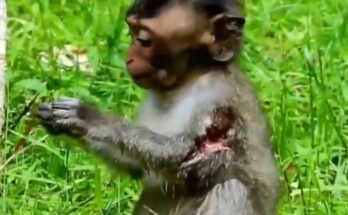
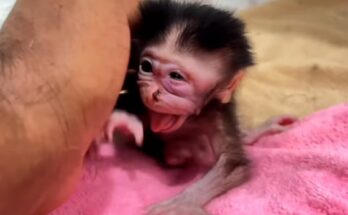
The old farmer, Mae Lin, found the trembling infant at the edge of her rice paddy, abandoned and crying. Her heart, wide and soft despite her own poverty, could not leave it. She carried the tiny monkey home, whispering comforts. But a crisis soon unfolded: she was a poor lady farmer who had only rice. She prepared a soft gruel, the same food that sustained her, and offered it to the baby. He nibbled weakly, but his cries continued—thin, reedy sounds of a need unmet. He needed milk.
Days passed. Mae Lin grew desperate. The rice could fill his tiny stomach but could not give him what he truly needed. He grew thinner, his eyes duller. She could see the life fading from him, and her heart broke with helplessness. She had saved him from the wild, but her poverty was failing him. He needed milk, and she had none to give.
Driven by love, Mae Lin wrapped the weakening infant in a cloth and walked miles to the nearest village temple, where she knew a monk sometimes helped animals. Weeping, she presented the baby. “I have only rice,” she confessed. “But he needs milk.”
The monk acted swiftly. He contacted a wildlife network. That very evening, a rescuer arrived on a motorbike, carrying a small kit. The rescuer showed Mae Lin how to feed the baby with a special formula from a syringe—the milk he needed. She watched, tears in her eyes, as the baby monkey latched onto the syringe and swallowed, his desperate cries ceasing at last.
The rescuer left a supply of formula and a small stipend for Mae Lin, thanking her for her compassion. Now, the poor lady farmer still has only rice for herself, but thanks to the bridge of kindness she helped build, the baby monkey finally gets the milk he needs. In her humble home, two survivors now thrive: one sustained by rice, the other by milk, and both by an unexpected bond that refused to let life slip away.