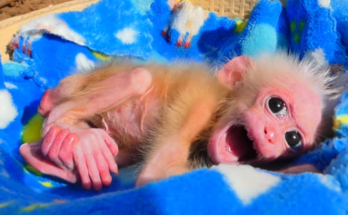
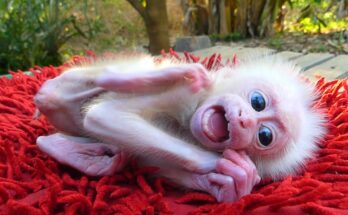
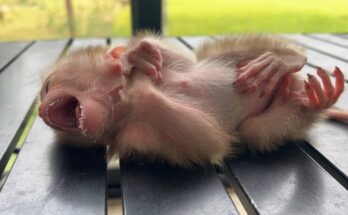
The little monkey, later named Kael, was found curled in a ditch—a tiny, broken form. He was badly injured: a deep gash across his side wept openly, one arm hung at a sickening angle, and his breathing came in shallow, ragged gasps. Flies buzzed around his wounds. He was not just hurt; his systems were shutting down from pain, blood loss, and shock. He was dying.
A farmer spotted the motionless bundle while checking his fields. Seeing the faint rise and fall of the monkey’s chest, he acted without hesitation. Wrapping Kael gently in a cloth, he rushed him to the nearest wildlife rescue outpost. That swift decision was the first link in a chain of luck that would save a life.
At the clinic, the veterinary team moved with urgent precision. The badly injured infant was in septic shock. They started an intravenous line to administer fluids, powerful antibiotics, and pain medication. They cleaned and stitched the ugly gash, removing debris and dirt to prevent fatal infection. An X-ray revealed a broken humerus, which was carefully set and cast. For the next 24 hours, Kael lay in an incubator, his life balanced on the edge of a razor.
But luckily, he was treated in time. The expert care began to turn the tide. The antibiotics fought the infection. The fluids reversed his dehydration. The pain relief allowed his body to rest and start healing. On the second day, he stirred. On the third, he accepted drops of formula from a syringe.
Today, Kael is a different creature. His wounds are healing into clean scars. His cast is off, and he is learning to use his arm again. He chatters for his meals and curiously explores his safe enclosure. The little monkey who was badly injured and dying is now very much alive—playing, growing, and thriving. His story shouts a powerful truth: that timely compassion and skilled treatment can snatch a life back from the brink, turning a tragic end into a vibrant new beginning.