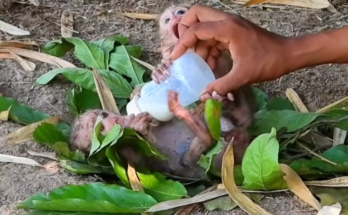
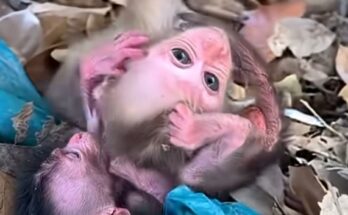
The sound was a raw, relentless plea—an abandoned baby monkey crying loudly, not just from hunger, but from a deeper, more terrifying emptiness. She was cold, alone on the forest floor, and her entire being screamed for one thing: she needed her mom holding her. That primal need for contact, for the safety of arms wrapped around her, was as vital as milk. Every cry was a vocalization of that physical void: her skin missed the warmth of another body, her trembling back needed the pressure of a secure grip, her face longed to be buried in familiar fur.
She cried until her voice grew hoarse, her small body curled into a tight ball as if trying to mimic the feeling of being held. But the ground was hard and cold. Without her mom holding her, the world felt vast, chaotic, and full of threats. The instinct to cling was so strong her tiny hands opened and closed rhythmically, grasping at nothing but air.
Her salvation came when her weakening cries reached a farmer tending a nearby field. He followed the sound and found the shivering infant. Understanding her desperation, he did not just pick her up—he carefully scooped her into his cupped hands and immediately cradled her against his chest, one warm hand securely supporting her back. The moment she felt the enveloping warmth and steady heartbeat, her loud crying hitched. The need for mom holding her was so profound that even this human imitation of an embrace began to calm her nervous system.
Wrapped in a soft cloth at his home, she was held constantly, fed gently, and kept against a warm body. The crying loudly stopped. While it wasn’t her mother’s hold, it was a hold nonetheless—a sanctuary of touch that told her she was no longer falling through an uncaring world. For this abandoned baby, the deepest healing began not with food, but with the simple, life-saving truth of being securely held.