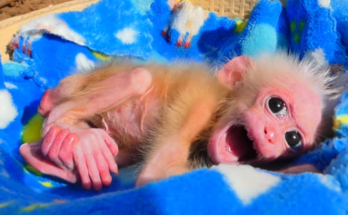
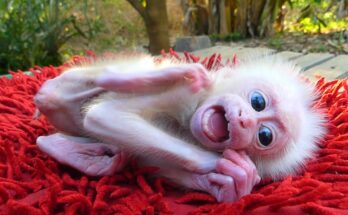
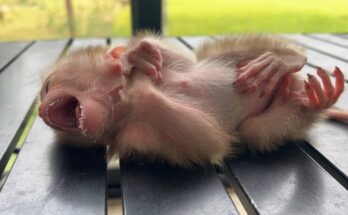
In a rare and somber procedure, wildlife veterinarians performed an emergency postmortem cesarean section to save an infant after its mother was found deceased. The mother, a pregnant monkey, had succumbed to injuries near a roadway. During the examination, a subtle movement was detected in her abdomen—a faint sign of fetal life. A critical decision was made to attempt to rescue the baby monkey from its deceased mother’s womb.
Time was measured in heartbeats. In a sterile field, the veterinary team worked with urgent precision. A careful incision was made, and the tiny, fluid-covered infant was gently lifted out. It was a fully formed newborn, its umbilical cord still pulsing faintly, connected to a placenta that could no longer sustain it. For a terrifying moment, the infant was limp and silent, not breathing.
Immediate neonatal resuscitation began. The team cleared its airways, provided gentle stimulation, and administered warm oxygen. After several tense seconds, a tiny gasp was heard, followed by a weak but determined cry—the sound of a life abruptly transitioning from one world to another.
The baby, named Anya (meaning “grace”), was swiftly stabilized. Her cord was carefully clamped, cut, and sterilized. Weighing only a few ounces, she was placed in a warmed incubator and began the fight of her life. As a baby monkey rescued from her deceased mother’s womb, she missed all the critical first moments of maternal care: the cleansing licks, the first milk, the warmth of a living heartbeat.
Her survival now depends on round-the-clock, surrogate care. She is fed a special colostrum formula every two hours, kept in a humidified incubator, and her development is monitored meticulously. Her rescue is a profound blend of tragedy and miracle—a life saved from death, a story that begins with loss but is now defined by fragility, hope, and the unwavering human commitment to honor a mother’s lost life by fiercely protecting the one she left behind.