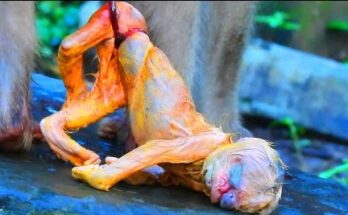
In the animal kingdom, a young mother giving birth in water is an event of extreme rarity and acute danger—especially for tree-dwelling primates like monkeys. While some mammals (e.g., dolphins, hippos) are adapted for aquatic births, monkeys are not. If a young monkey mother were forced by circumstance—such as a sudden flood, a fall into a river, or a panicked escape from a predator—to deliver in water, the outcome would be a desperate race against time.
1. Immediate Crisis for the Newborn
The infant would be born into a hostile environment. Its first breath, if taken underwater, would lead to drowning. Even if the head emerges quickly, the risk of aspiration pneumonia from inhaled water is high. Water also saps body heat 25 times faster than air, putting the newborn at immediate risk of deadly hypothermia.
2. The Mother’s Instinctual Response
A young mother’s inexperience could compound the danger, but primal instinct would likely take over. She would rapidly scoop the infant to the surface, using one hand to hold its head above water while clinging to branches or rocks with the other. She would then bite through the umbilical cord (if not already broken) and climb to dry land with the newborn clutched tightly.
3. Critical Aftermath on Land
Once ashore, the mother would work intensely to stimulate breathing and warmth. She would:
- Vigorously lick the infant to clear its airways, dry its fur, and encourage circulation.
- Hold it against her body for heat transfer.
- Attempt to nurse quickly, as suckling helps stabilize a newborn’s temperature and blood sugar.
4. Long-Term Survival Risks
Even if the initial rescue succeeds, the ordeal leaves lasting threats:
- Infection from contaminated water entering the umbilical stump or lungs.
- Weak bonding due to disrupted early nursing and grooming.
- Predator exposure if the mother is exhausted or stranded in an unsafe area.
5. The Role of the Troop
If other troop members are nearby, they may assist—creating a distraction, helping the mother climb, or even sharing warmth with the infant. However, in many cases, the young mother would be alone, relying solely on her instincts.
In a Nutshell
A young mother giving birth in water faces a life-or-death scenario. While not biologically adapted for it, her fierce maternal drive would push her to save the newborn against steep odds. Success would depend on her ability to quickly reach land, revive the infant, and overcome the aftereffects of a traumatic entrance into the world. In the wild, such an event underscores the fragility and resilience of life—where a single moment can define survival.