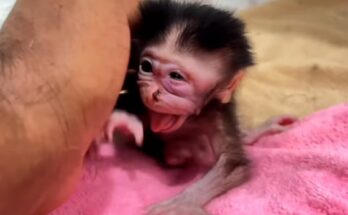
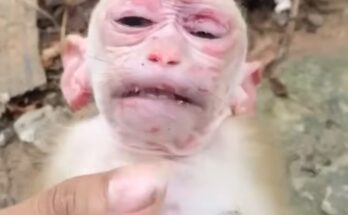
When little Leo was first rescued, he was frail and quiet, but there was still a light in his eyes. We hoped that warmth, food, and safety would be enough to nurse him back to health. But now, a terrifying uncertainty hangs over his recovery. The poor baby’s condition is worsening, and while we rush to find answers, we still don’t know what illness he has.
It started with a loss of appetite. The bottle of warm milk he usually gulped down eagerly was now ignored. His playful chirps have vanished, replaced by a listless silence. He no longer clings to his soft toy but lies curled in a corner of his enclosure, shivering despite the warm blankets. The most alarming change is his breathing—it has become labored and raspy, each breath a visible struggle. His once-bright eyes are now clouded with a feverish haze, and he flinches when touched, as if his small body is in constant, deep-seated pain.
Our team is working around the clock. We’ve taken blood samples, checked his temperature incessantly, and consulted wildlife disease databases. Is it a respiratory infection? A parasitic invasion? Or something more sinister, like a virus we haven’t encountered? Every theory leads to a new treatment, but so far, nothing has stopped his decline. The helplessness is the hardest part—watching him grow weaker while the mystery deepens. He looks up at us, and it feels like he’s asking a question we cannot answer.
Yet, we refuse to give up. He is now on a regimen of broad-spectrum antibiotics and supportive fluids to keep him hydrated. We monitor him through the night, hoping for any small sign of improvement—a single sip of water, a moment where his breathing eases.
This is the heartbreaking reality of wildlife rescue. Sometimes, the greatest enemy is the unknown. But as long as Leo fights, we will fight for him. We will not stop searching for the answer to save this poor baby, whose only chance depends on our perseverance and his own fragile, incredible will to live.