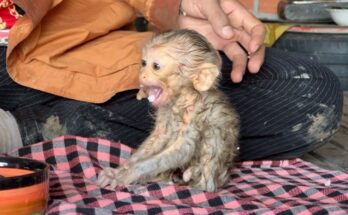
In the harsh calculus of the wild, weakness is a luxury none can afford. For one tiny newborn monkey, this truth became a crushing reality almost from its first breath. Abandoned in a shallow nest of leaves, he was the embodiment of vulnerability—a fragile life already teetering on the edge. His mother, perhaps a first-time parent overwhelmed by instinct or a starving female unable to support another mouth, had vanished. He was left with nothing: no mom, no milk, and a future measured in hours.
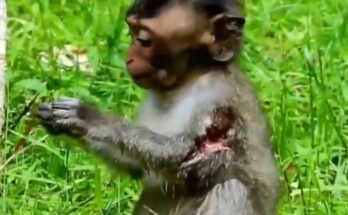
He was so weak he could barely lift his head. His body, skeletal and small, was wracked by faint tremors. His skin, where visible through the thin, patchy fur, had a pallid, almost translucent quality. The greatest tragedy was in his eyes—they were open, dull with exhaustion and hunger, staring out at a world that had rejected him with a look of profound, silent confusion. He did not have the strength to cry loudly. Instead, he emitted faint, breathy whimpers, each one a ghost of a plea. His mouth opened and closed in a futile, rhythmic motion, seeking a nourishment that was nowhere to be found.
The absence of milk was a clock ticking down inside him. His energy, borrowed from his mother’s womb, was depleting rapidly. He made a feeble attempt to crawl, his limbs flailing weakly before he collapsed back into the leaves, utterly spent. He looked so pitiful, a mere sketch of life, slowly fading away in the vast, indifferent forest. The world carried on around him—insects buzzed, birds sang, the sun shone—oblivious to the tiny tragedy unfolding in the undergrowth.
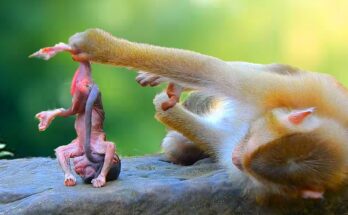
Yet, nature sometimes offers a reprieve. A troop member, an older female whose own infant had recently perished, paused in her foraging. Her experienced eyes saw the pitiful sight, and her instincts, sharpened by loss, overrode the troop’s general indifference to weakness. She approached cautiously. She did not immediately scoop him up, but instead, she gently nuzzled him, her nose taking in his scent.
A soft, clicking sound came from her throat—a sound of recognition, of pity. She then began to groom him, her rough tongue stimulating his cold skin. The weak baby, feeling a warmth and attention it thought lost forever, managed a faint, almost imperceptible squeak. It was not a cry of pain, but one of recognition. He was seen. As the female finally gathered him into the safety of her arms, the pitiful whimpers ceased. The weakness remained, but the abandonment had ended. In the compassionate heart of a surrogate, the fight for life was given a second chance.