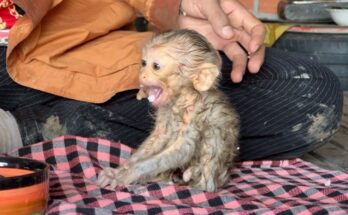
In the heart of the troop, a scene unfolds that chills the observer to the bone. While other mothers cradle their newborns, gently grooming their soft fur, one mother, named Asha, shows only cold indifference and sharp irritation toward her own infant, a tiny son named LEO. There is no bond, no softness—only a relationship of strained tolerance that frequently shatters into violence.
When LEO, driven by instinct and hunger, tries to nurse, Asha often yanks him away with a rough pull of her arm, sending him tumbling. His desperate, wailing cries for nourishment and comfort are met not with solace, but with a swift, stinging slap. The sharp sound echoes, followed by the baby’s intensified, terrified screams. He cannot understand why his mother, his entire world, is a source of pain. He will try to cling to her back for safety as the troop moves, only for her to reach back, peel his tiny hands away, and let him fall onto the hard branch below, leaving him to scramble and cry loudly in her wake.
This relentless rejection is not merely cruelty for its own sake. In the harsh reality of the wild, a mother’s energy is a precious resource. Asha may be malnourished, ill, or profoundly stressed, her own survival instincts overriding her maternal ones. Her body and mind may be signaling that she simply does not have the capacity to raise this infant. By pulling, slapping, and neglecting, she is, in a brutal sense, rejecting a drain on her own fragile existence. She is teaching him a horrific first lesson: that he is unwelcome and must be silent to avoid attracting predators or provoking her further.
Little LEO, the poorest soul, is learning a world of isolation. His spirit is being broken by the very one meant to nurture it. However, his desperate cries are not entirely in vain. In a troop, community can sometimes intervene. An older, more experienced female—perhaps a grandmother or an aunt who has lost her own infant—may hear his pitiful sobs. She may step in, gathering the shivering baby into her own arms, offering the grooming, warmth, and protection his own mother denies him. In this act of communal compassion lies LEO’s only hope—a chance that love can be found elsewhere, even when a mother’s love is tragically absent.